
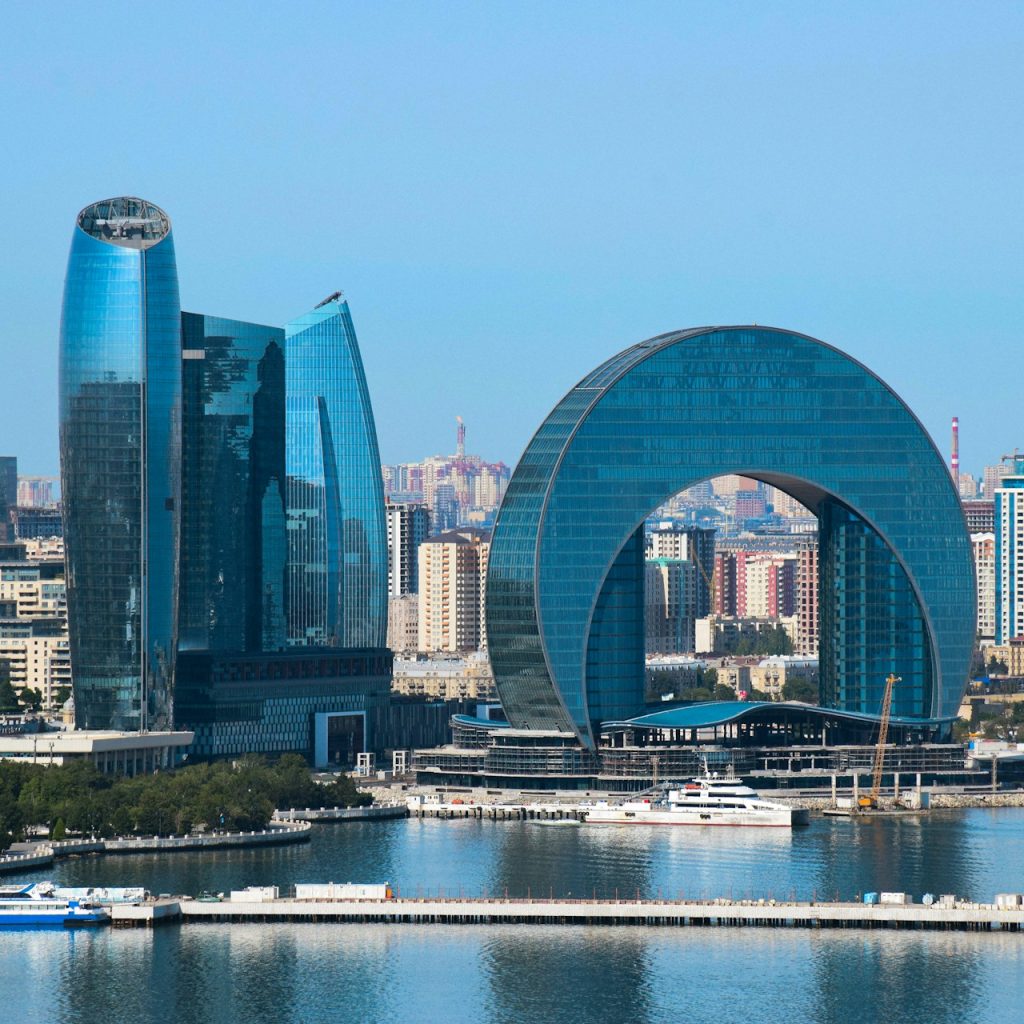
Azerbaijan sits at the crossroads of Eastern Europe and Western Asia, with landscapes that change dramatically from one region to another. Baku has a modern skyline and a centuries-old walled city, while the north opens into the Caucasus Mountains, historic towns and high-altitude villages. In the south, tea plantations, citrus orchards and ancient forests create a greener setting along the Caspian coast. (Azerbaijan Travel)
The country is often called the “Land of Fire,” but its attractions go far beyond this nickname. Azerbaijan has Silk Road heritage, medieval palaces, mountain resorts, unusual geological landscapes, national parks and distinctive local food. Spending time outside Baku gives you a much broader view of the country and its different regions.
Baku
Baku is Azerbaijan’s capital and largest city, sitting on the Caspian Sea. It is the easiest place to begin exploring the country because historic neighbourhoods, modern architecture, museums, restaurants and the waterfront are all within the city. The contrast between old and new is one of Baku’s defining features. (Azerbaijan Travel)
Icherisheher, or the Old City, is a UNESCO World Heritage Site enclosed by historic walls. Its narrow streets lead to the Maiden Tower and the Palace of the Shirvanshahs, two of the city’s best-known historical landmarks. The Heydar Aliyev Center provides a completely different experience, with its sweeping white design by architect Zaha Hadid. The Flame Towers rise above the city and become especially striking after dark.
Baku Boulevard stretches along the Caspian waterfront and is a good place for an evening walk after exploring the Old City. Give Baku at least two or three days to see the main sights at a comfortable pace, and check current opening hours and entrance fees before visiting individual attractions.
Ganja
Ganja is Azerbaijan’s second-largest city and one of its oldest cultural centres. The city is closely associated with Nizami Ganjavi, the celebrated Azerbaijani poet, and its streets, parks and historic sites provide a quieter experience than the capital. The official tourism authority also highlights Ganja for its history, food and connection with Nizami. (Azerbaijan Travel)
The Nizami Ganjavi Mausoleum and Museum is one of the city’s main cultural attractions, while the Imamzadeh Complex is known for its distinctive religious architecture. Javad Khan Street brings together cafés, shops and everyday city life, making it a pleasant area to explore on foot. The Bottle House is another unusual sight, decorated with thousands of glass bottles.
Ganja is about four hours from Baku by train, with road connections also available. One night is enough to explore the main attractions, while two nights give more time for nearby excursions.
Gabala
Gabala sits in the Greater Caucasus and is surrounded by forests, mountain slopes, waterfalls and lakes. Tufandag Mountain Resort provides cable car rides and mountain activities, while winter brings skiing and other snow-based activities. Nohur Lake is another popular stop, with wooded hills and mountain scenery around the water. (Azerbaijan Travel)
The area also has waterfalls and hiking routes for those who want to spend more time outdoors. Gabala’s cooler mountain environment makes it particularly appealing during warmer months, while the ski facilities make winter a popular time to visit.
Gabala is roughly three to four hours from Baku by road. Stay for one or two nights to explore the mountain resort, Nohur Lake and surrounding natural attractions. A longer stay gives more time for hiking and seasonal activities.
Quba and Khinalug
Quba is one of the main destinations in northern Azerbaijan and is known for its orchards, carpet-making traditions, mountain scenery and diverse communities. The town provides access to several interesting places in the surrounding region, including Krasnaya Sloboda, a historic settlement associated with Azerbaijan’s Mountain Jewish community. Quba is also one of the destinations officially highlighted along Azerbaijan’s northern tourism route. (Azerbaijan Travel)
The journey deeper into the mountains leads to Khinalug, also known as Xinaliq. Sitting more than 2,000 metres above sea level, the village is surrounded by steep Caucasus mountains and has preserved distinctive traditions and a local language. Stone houses follow the slopes, while walking routes lead into the surrounding highlands.
Quba is roughly two to three hours from Baku by road. Khinalug requires additional driving on winding mountain roads, so allow plenty of time for the journey. A night in Quba works for a short northern trip, while adding an overnight stay in or near Khinalug gives more time to experience the mountain landscape.
Sheki
Sheki is one of Azerbaijan’s most appealing historic towns, with a strong connection to the Silk Road and the trading routes that once passed through the Caucasus. The town sits against the forested slopes of the Greater Caucasus and has a compact historic centre that is easy to explore on foot. (Azerbaijan Travel)
The Palace of the Sheki Khans is the main attraction. Its painted interiors, carved wooden details and colourful shebeke windows make it one of the country’s most distinctive historic buildings. The shebeke windows are made from small pieces of coloured glass fitted into wooden frames, creating intricate geometric patterns without ordinary nails or glue.
Sheki’s historic caravanserais also reflect its role as a trading centre, while local shops sell the town’s famous sweets, including Sheki halva. The drive from Baku takes around four to five hours, so stay for one or two nights to explore the palace, historic centre, local food and surrounding scenery.
Shusha
Shusha is a mountain city in the Karabakh region with deep connections to Azerbaijani music, poetry, carpet weaving and architecture. Its position among the Lesser Caucasus Mountains gives the city impressive views, but its cultural heritage is the main reason to include it in an Azerbaijan itinerary. (Azerbaijan Travel)
Shusha Fortress is one of the city’s defining historic landmarks, while the Yukhari Govhar Agha Mosque is a notable part of its architectural heritage. The Vagif Mausoleum, Mehmandarovs’ Estate Complex and Shusha Carpet Museum add further insight into the city’s cultural history. Jidir Duzu provides wide mountain views and is one of the best-known natural viewpoints around Shusha. (Azerbaijan Travel)
Foreign nationals can visit Shusha and other designated areas of Karabakh under the current permit system. Check the latest entry requirements, permitted routes and local travel conditions before visiting, as access rules can change. (Tourism Azerbaijan)
Lankaran
Lankaran lies on the southern Caspian coast between the sea and the Talysh Mountains. Its subtropical climate supports tea plantations, citrus orchards and lush vegetation, giving the region a noticeably different character from the dry landscapes around Baku and the mountain areas farther north. (Azerbaijan Travel)
Tea is an important part of local life, and plantation visits offer a closer look at the region’s tea-growing tradition. Lankaran also has its own food culture, with regional dishes and seafood featuring strongly in local restaurants. The town’s historic sites provide another reason to spend time in the area.
Hirkan National Park is the main natural attraction nearby. Its ancient forests contain rare plant species and support a rich range of wildlife. Lankaran is about five to six hours from Baku by road, so stay for one or two nights to explore the town, plantations and surrounding forests.
Nakhchivan
Nakhchivan is an autonomous region of Azerbaijan separated from the mainland by Armenia. Its distinctive geography has helped preserve a strong local character, with medieval monuments, mountain landscapes, sacred sites and historic settlements spread across the region. The official tourism authority lists Nakhchivan among Azerbaijan’s major destinations. (Azerbaijan Travel)
The Momine Khatun Mausoleum is one of Nakhchivan’s most remarkable landmarks. Built in the 12th century, it is covered with detailed geometric decoration and is considered one of the finest examples of medieval architecture in Azerbaijan. Alinja Castle is another major attraction, standing high on a mountain and offering extensive views across the surrounding landscape.
Other places to explore include Ashabi-Kahf cave, Duzdag and the historic town of Ordubad. Because Nakhchivan is separated from mainland Azerbaijan, flying from Baku is generally the most practical way to reach the region. Stay for two or three nights to explore the main monuments and take trips beyond the city.
Naftalan
Naftalan is a small resort town known for its distinctive naphthalene oil, which has been used in local therapeutic treatments for generations. Today, specialised sanatoriums offer supervised oil-based treatments alongside other wellness services. The destination has developed around this unusual part of Azerbaijan’s health and wellness tradition. (Azerbaijan Travel)
The main reason to visit Naftalan is the treatment experience rather than a long list of sightseeing attractions. Facilities in the town provide structured programmes, so check the services offered by your chosen centre before booking and use qualified professionals for any treatment.
Naftalan is around four to five hours from Baku by road. A one- to three-night stay can fit well depending on the treatment programme and the amount of time available for exploring the surrounding region.
Absheron National Park
Absheron National Park sits on the southeastern end of the Absheron Peninsula, within Baku’s wider administrative area. The park covers 783 hectares of semi-desert and coastal landscape and was established to protect wildlife and rare plant and animal species. More than 50 bird and animal species have been recorded in the park. (azerbaijan.az)
The Caspian shoreline is one of its main attractions, while the open landscape provides opportunities to observe birds and other wildlife. The park also offers a quieter setting for walking and photography away from the built-up parts of Baku.
Its location makes it easy to add to a Baku itinerary without travelling deep into the country. Check current opening arrangements before setting out, and carry water and sun protection when exploring the exposed coastal landscape.